
The change rarely arrives on a day you can name. At 70 your father walks to the market. Some years later he waits for someone to go with him, and nobody at home can say when that started.
There is no fixed age at which a parent needs help. Caring for elderly parents at home starts with noticing what has changed for that person: how they walk, manage medicines and spend their day.
What we saw in the homes we visit
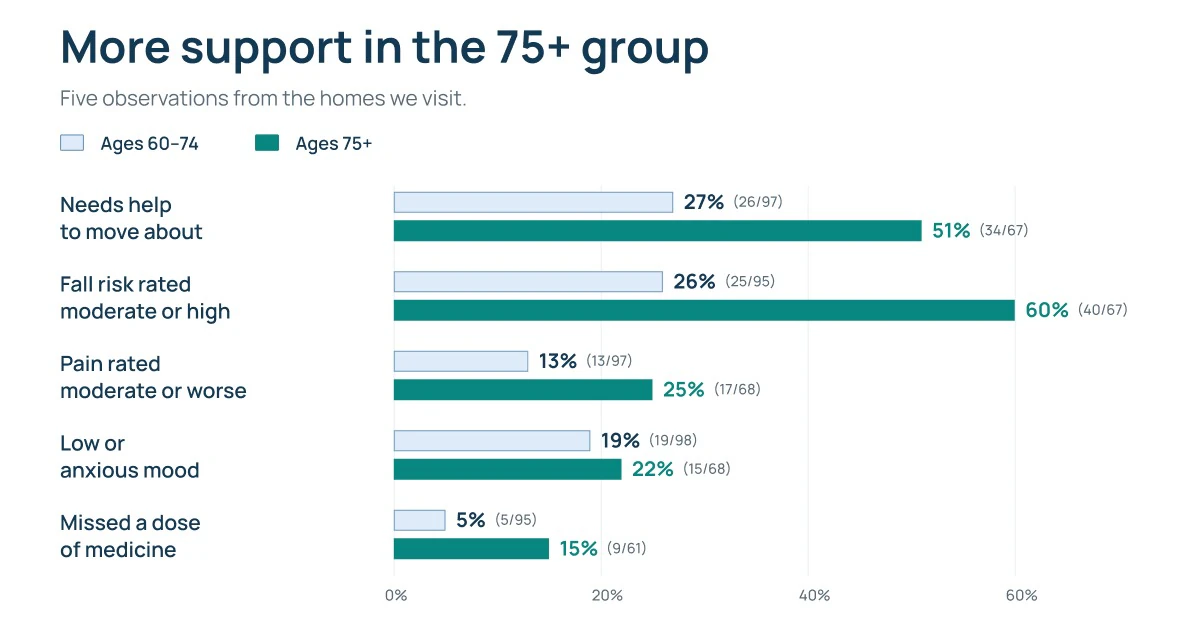
YORO’s care records from 25 April to 12 November 2026 included 166 people aged 60 or over: 98 aged 60-74 and 68 aged 75 and above. We compared the staff ratings at each person’s latest visit.
| At the latest visit | Ages 60-74 | Ages 75+ |
|---|---|---|
| Not independently mobile | 27% (26 of 97) | 51% (34 of 67) |
| Fall risk rated moderate or high | 26% (25 of 95) | 60% (40 of 67) |
| Pain rated moderate or worse | 13% (13 of 97) | 25% (17 of 68) |
| Mood rated low or anxious | 19% (19 of 98) | 22% (15 of 68) |
| A missed medicine dose recorded | 5% (5 of 95) | 15% (9 of 61) |
The available records differ by measure; percentages are rounded. Needing help to move and a moderate or high fall-risk rating were more common in the older group. Missed doses were also more common, although the numbers were small. The difference in mood was modest.
These staff ratings compare different people already receiving home care. They do not establish 75 as a turning point or predict what will happen to one parent.
A blood-pressure finding worth following up
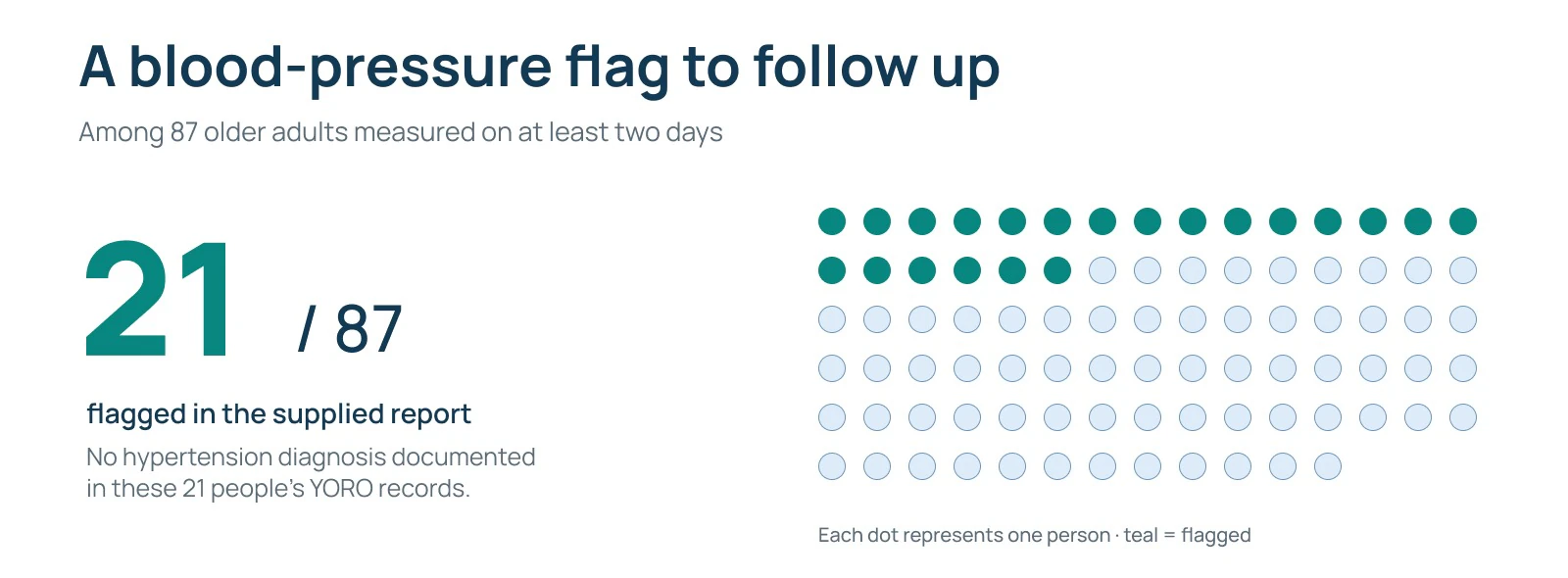
Among 87 older adults with blood-pressure measurements on at least two days, 21 (24%) were flagged by the report’s rule: a median systolic reading of at least 140 mmHg or a median diastolic reading of at least 90 mmHg. Here, median means the middle value across a person’s readings.
None of these 21 had hypertension documented in the records reviewed. That does not prove they had never been diagnosed. A diagnosis, prescription or treatment history may simply be missing.
Check the history and share the readings with the treating doctor. These flags are not 21 confirmed new diagnoses or a treatment target for every older adult.
The wider picture also matters. WHO’s 2023 India hypertension profile, using 2019 estimates, put age-standardised prevalence among adults aged 30-79 at 31%. Of adults with hypertension, an estimated 37% had been diagnosed. Those national estimates are context, not a direct comparison with YORO’s smaller care group.
What the national ageing survey adds
A 2023 analysis of LASI’s 2017-18 data included 24,136 people aged 60 or over. About 20% had difficulty with at least one basic daily activity, 45% with activities such as shopping, managing money or medicines, and 12% reported a fall in the preceding two years.
These measures are different from our latest-visit staff ratings. In particular, a reported fall over two years cannot be compared directly with a current fall-risk rating.
Read our figures as a view of needs within the homes we visit, not a forecast of old age.
Five checks you can do this weekend
1. Watch the walk
During their usual routine, does your parent reach for furniture or a wall, hesitate when turning, or need more help getting up? Ask what feels different. Do not ask them to attempt an unsafe walk to prove they can manage.
2. Ask about near-falls as well as falls
“Have you slipped, stumbled or lost your balance recently?” may uncover something a question about falls misses. Note when it happened and discuss it with the doctor or a physiotherapist. Check loose rugs, clutter, lighting and slippery bathroom floors.
3. Review medicines together
Compare the current prescription with the medicines actually being taken. Ask about missed doses, side effects and trouble opening packs or remembering timings. Tablet counts can help, but changed prescriptions and medicines taken only when needed can make them misleading.
For a missed dose, check the medicine instructions or ask the pharmacist or prescriber. Do not double a dose unless the prescriber advises it.
4. Listen to their week
Who have they spoken to? Have they stopped a walk, a visit or another activity they enjoy? Ask about pain, sleep and how they are feeling. Persistent changes are worth discussing with their doctor; a quiet week alone is not a diagnosis.
5. Make a blood-pressure record the doctor can use
Agree the monitoring schedule with the doctor. Use a validated upper-arm monitor with the right cuff size. Rest quietly for five minutes, sit with back and feet supported, and support the bare arm at heart level. Take two readings one minute apart and record both. Do not change medicines yourself.
These checks give you something concrete to discuss. They do not replace a clinical assessment.
When to act sooner: If the upper reading is above 180 or the lower above 120 mmHg, repeat after at least one minute if there are no emergency symptoms; if it remains very high, contact a healthcare professional immediately. With chest pain, breathlessness, sudden weakness, vision changes or difficulty speaking, seek emergency care immediately. Do not wait to finish a week’s log.
Where YORO fits
YORO brings care notes and vitals together in one record, helping families follow visits and discuss changes with the treating doctor.
If your parent lives in Amanora, Kharadi or Magarpatta, ask about a vitals visit on WhatsApp. Share the address and the support needed; our team will confirm availability and charges. You can also explore physiotherapy at home.
Download the YORO app for Android or iPhone.
Quick questions
At what age do parents usually start needing help at home?
There is no fixed age. Look for changes in everyday tasks and discuss support with your parent. The differences in YORO’s age groups do not set a deadline for anyone’s independence.
How do I know if my parent may be at risk of falling?
New unsteadiness, near-falls or difficulty getting up deserve attention. Ask the doctor or physiotherapist for an assessment, including walking, balance, medicines and the home environment.
Does one high blood-pressure reading mean hypertension?
One reading does not establish a diagnosis. Record readings as advised and discuss them with the doctor. Very high readings or emergency symptoms need prompt action, as described above.
Related reading: Discharge day needs a plan for home.
Further reading: American Heart Association: home blood-pressure monitoring, CDC: preventing falls, and NHS Specialist Pharmacy Service: missed medicines.