At YORO’s published card rate, a caregiver’s hour costs Rs 199 (August 2026). A twelve-hour day is Rs 2,388. Families ask us, reasonably, where that goes, and whether a provider quoting Rs 99 or Rs 120 is simply more efficient. This article answers with arithmetic rather than adjectives. Every number below is an assumption we state, not a figure from our accounts, because the structure of the cost is the point and it is the same for every provider in the city.
The hour you pay for is not the hour the caregiver is paid for
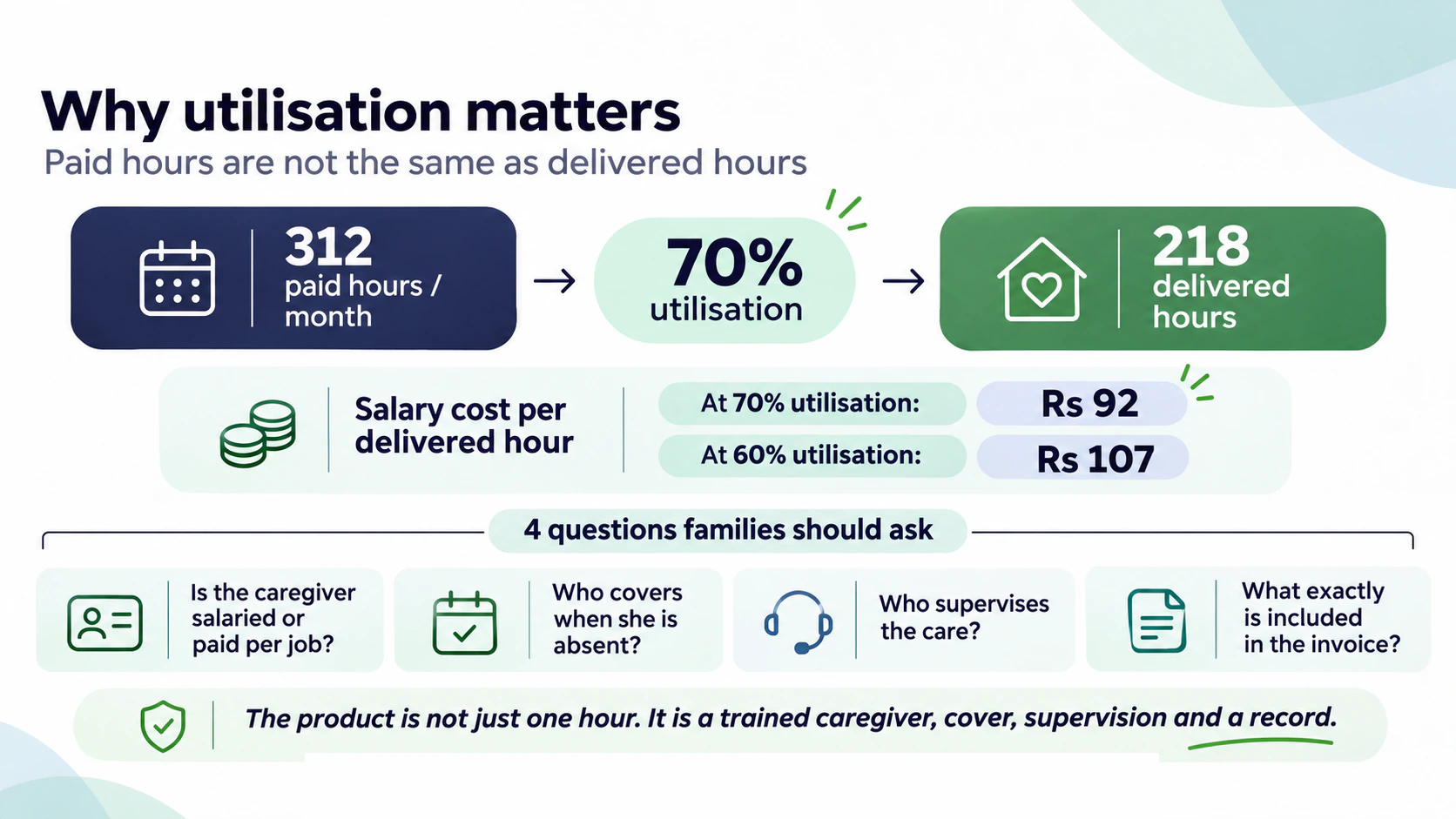
Start with a hypothetical caregiver on Rs 20,000 a month. She works 26 duty days of 12 hours: 312 paid hours, or Rs 64 an hour. That is the number most people have in their head when they say a care hour “should” cost Rs 80 or Rs 100.
But a salaried caregiver is paid for the duty day whether or not a home has booked her. Between visits she travels, waits for a plan to resume, covers for a colleague, or sits idle because the township’s demand that day was three homes and not five. The share of paid hours actually spent in a home is utilisation, and it decides the cost of a delivered hour more than the salary does.
At 70 percent utilisation, each hour in a home carries Rs 92 of salary (Rs 64 divided by 0.7). At 60 percent, Rs 107. At 90 percent, which is a very full day with no travel and no gaps, Rs 71. No provider publishes this number, and it is the first question to ask anyone quoting a price: how many of your caregiver’s paid hours are billed?
Three costs that never appear on an invoice
Statutory contributions and insurance. Provident fund, state insurance and accident cover for a salaried worker add, on our assumption, 15 percent to the salary: Rs 14 on a delivered hour at 70 percent utilisation. A provider that treats the caregiver as a contractor skips this, and the worker carries the risk.
Cover for absence. People fall ill and take leave. If 8 of every 100 duty days are absences, someone else is paid to cover them or the family goes without. On our assumption that adds Rs 7 an hour.
Training before the first visit. YORO runs a ten-day academy before deployment (as described in August 2026). Ten days of pay before a single billable hour, spread over a year’s tenure, is about Rs 3 an hour. Small, but it is where “trained” either means something or does not.
Supervision. A care manager who checks the record, visits the home when something changes and takes the call at 11 pm: one for every 15 caregivers, on our assumption, at Rs 35,000 a month, is Rs 11 on each delivered hour.
Travel, the record and consumables. Rs 50 a day of travel across a township is Rs 6 an hour. The app, the visit record, gloves, a thermometer, a blood-pressure cuff: Rs 10 an hour as a round assumption.
Tax. Whether GST applies depends on how the service is classified. Health services from a clinical establishment are exempt; non-clinical home services are often taxed at 18 percent. If it applies, Rs 30 of the Rs 199 is tax before anyone is paid.
Where Rs 199 goes, at 70 percent utilisation
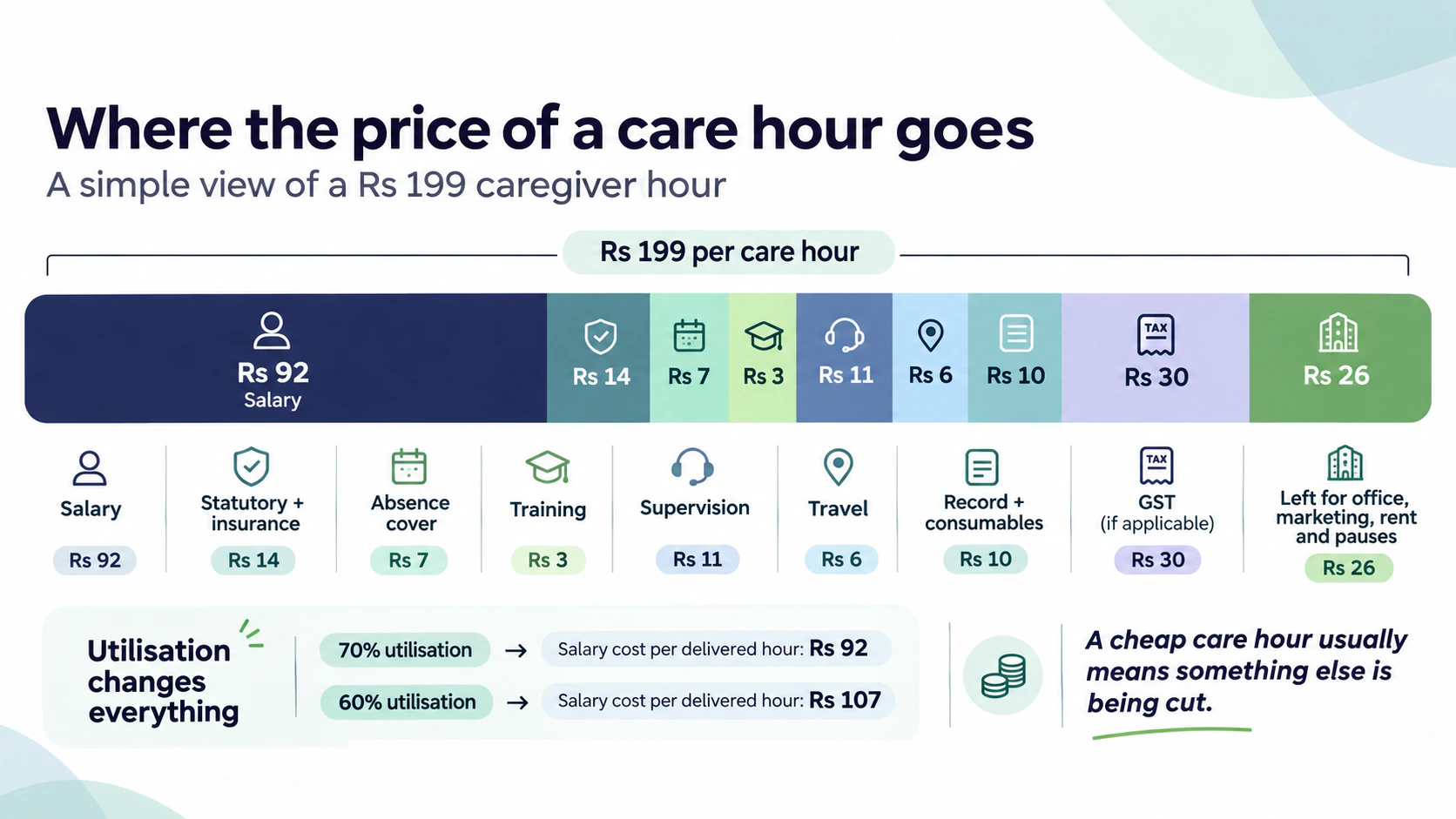
Salary Rs 92. Statutory and insurance Rs 14. Absence cover Rs 7. Training Rs 3. Supervision Rs 11. Travel Rs 6. Record and consumables Rs 10. GST, if applicable, Rs 30. Total Rs 173. Left over: Rs 26 an hour for the office, marketing, rent, bad debt and the months when a home pauses.
Change one assumption and watch the line move. At 60 percent utilisation the salary alone rises to Rs 107 and the remainder falls to about Rs 5. Without GST, the remainder at 70 percent is Rs 56, which is why the classification question matters to every provider in the country.
Why the launch price cannot be the price
Many providers, including us in a new micro-market, have offered Rs 99 an hour to start. At Rs 99 and 70 percent utilisation, salary alone is Rs 92; add contributions and cover and the hour loses money before training, supervision or tax. A launch price buys a routine and a record for a few months. It does not pay for the caregiver, and anyone who tells you it does is either subsidising it for a while or underpaying someone.
The reporting in The Ken this year followed a caregiver on Rs 24,000 a month for 24-hour shifts, of which the agency kept Rs 5,000. She left for an office job at the same pay and an eight-hour day. That is what a cheap hour usually is: a long shift, an agency cut, no cover and no supervisor.
What this means for a family choosing a provider
Four questions settle most of it. Is the caregiver salaried or paid per job? Who comes when she is absent, and does the family pay twice? Who supervises her, and how would you reach that person at night? What does the invoice include: the hour, the travel, the tax, the record?
The honest answer from any provider will put a floor under the price. Ours is above Rs 150 an hour at the utilisation a dense micro-market can reach, which is why we build one township at a time and why the plan, not the single visit, is the product.
Frequently asked questions
Is Rs 199 an hour what YORO charges?
Rs 199 an hour is the daily-care card rate YORO published in August 2026. Plans and launch pricing in a given micro-market can differ; the app shows the price for your building before you confirm.
Does GST apply to caregiving at home?
It depends on how the service is classified. Health services from a clinical establishment are exempt; non-clinical home services are often taxed at 18 percent. Ask your provider what the invoice includes and take advice for your own case.
Why does utilisation matter so much?
A salaried caregiver is paid for the duty day whether or not a home has booked her. The share of paid hours spent in a home decides what each delivered hour costs, more than the salary itself does.